|
Wednesday,
April 29, 2009
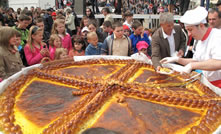
Largest Easter Bread with Cheese (“Pasca”): world record set by Radauti city
RADAUTI, Suceava, Romania – The town-hall of the town
of Radauti displayed an “Easter
Bread with Cheese”
(“Pasca”) having 2.10 meters in diameter, being
10 cm tall and weighing 170 kilograms – establishing the world
record for the Largest
Easter Bread with Cheese (“Pasca”). 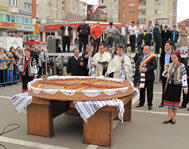
Photo: The Largest
Easter Bread with Cheese
("Pasca") was put in a wickerwork basket
and placed in front of 'Pogorarea Sfantului Duh' (Holy Spirit
Descent) Orthodox Cathedral in Radauti. (enlarge
photo)
The Mayor of the municipality of Radauti,
Aurel Olarean, said: “We take part in a special event
for the Municipality of Radauti, the homologation of the record
for the Largest
Easter bread with Cheese. We hope, by means of this
record, to draw the attention of the tourists from all around
Romania and from the entire world on our area.”
Several dozen kilograms of flour, 45 kilograms
of cottage cheese, 300 eggs and three kilograms of raisins
were used for its preparation. “Ten people worked for ten
hours to prepare the Easter
Bread with Cheese”, indicated Svetlana Amariei,
head of production at Mopan
SA Suceava, the bread factory which prepared the product.
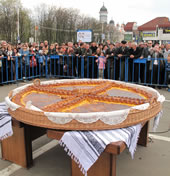
“Its shape is round because this is
what the tradition requires, symbolizing perfection, having
a cross in the middle and a dough ring all around it”- stated
Gabriel Flutur, head of service within the town-hall
of Radauti, the project coordinator.
(enlarge
photo)
“We are path breakers as there is no other Easter
Bread with Cheese recorded in the Book of World Records."
The representative of the World Record Academy, who homologated this record, stated: “The World Record Academy homologates numerous cooking records, but the one
done today has a special significance: the Easter bread with
cheese ("Pasca") is the symbol of the Earth, of
perfection. So much more as it is prepared here, in the legendary
province of Bucovina!”
 After
having been blessed, measured and homologated by the representative
of the World Record Academy, the huge Easter bread with cheese
was cut and distributed to the believers who participated
in the Resurrection religious service in “Pogorarea Sfantului
Duh” (Holy Spirit Descent) Cathedral in the town of Radauti.
(enlarge
photo) After
having been blessed, measured and homologated by the representative
of the World Record Academy, the huge Easter bread with cheese
was cut and distributed to the believers who participated
in the Resurrection religious service in “Pogorarea Sfantului
Duh” (Holy Spirit Descent) Cathedral in the town of Radauti.
(enlarge
photo)
The Largest
Easter Bread with Cheese (“Pasca”) was sponsored by
SC
Mopan SA Suceava, Inox Prim SRL, Cooperativa
"Munca Invalizilor" (Labor Cooperative of the
Disabled) and SC Mara-Alex SRL.
The two world records established by
local authorities in the County of Suceava (the Largest
Painted Easter Egg and the Largest
Easter Bread with Cheese -"Pasca") are part
of a series of manifestations organized within a tourism promotion
program in the County of Suceava, entitled “Easter in Bucovina”
and performed by the District
Council of Suceava in partnership with the Archiepiscopacy
of Suceava and Radauti, the Ministry
of Tourism and 40 town-halls in the county.
The National
Geographic Society, with a grant from the U.S. Governement,
has published a Guide
for Romania to promote tourism.
(enlarge
photo)
The Guide
"Traveler: Romania" contain details about
main tourist attractions in Bucovina.
For Christians, the lamb, the Easter
bread with cheese and the wine are important symbols when
it comes to the Resurrection: the Lamb symbolizes Jesus Christ,
the Easter bread with cheese signifies His face and the wine
symbolizes sacrifice.
The shells of the eggs used for the “pasca”
are thrown in a river. This action has two explanations. It
is believed that the hens are protected this way of the hawks.
The major explanation is, however, the ancient
belief that the shells are taken by the river to the country
of the Good People, announcing them the Easter has came.
The Easter
bread with cheese ("Pasca") is baked only once
a year, on the Holy Easter. In some regions “Pasca”
is also baked on St. George Day.
A legend from Bucovina goes that
the “Pasca”
has been done from the times when Jesus was traveling to the
world together with his apostles. They remained a night at
a peasant house and when they left, he put food in their bags.
The apostles asked Jesus when the Easter is and
He replied that the Easter would be when they would find corn
bread in their bags. Looking in the bags, they noticed the
peasant had given them exactly corn bread, so that they knew
it was Easter time.
Wednesday,
April 29, 2009
Related world records:
Largest
popcorn ball-world record set by the Noble Popcorn Factory
Largest
Simultaneous Roast Meal-world record set by the East of England
Agricultural Society
Biggest
Kings' Cake (La Rosca de Reyes)-world record set by Mexican
bakers
|